The Rice Cake That Almost Melted Away: Tracing Shikuramen Through the Snow Country
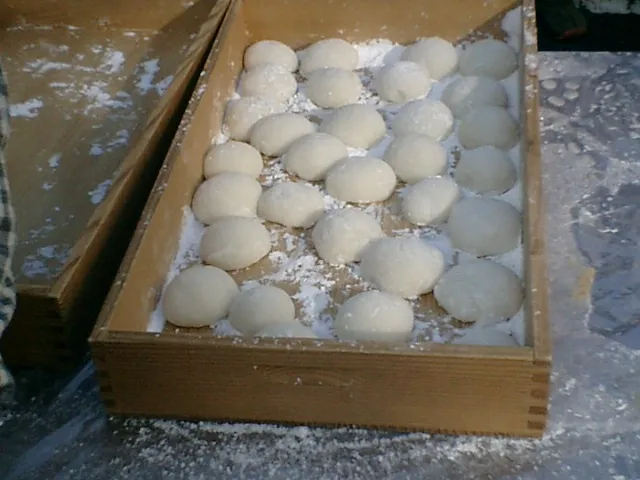
Photo: Unknown, CC BY-SA 3.0, via Wikimedia Commons
We named this site after a rice cake. It's worth explaining why.
Shikuramen is a regional mochi preparation from Japan's snow country — the heavy-snow belt running through the mountains of Tohoku and the Sea of Japan coast, where winters bury roads and families spend months eating from what they preserved in autumn. It's a modest thing on the plate: a small, dense rice cake, often layered or folded with a sweetened bean or soybean preparation, sometimes dusted, sometimes not. It is not famous. It does not appear in glossy tourism brochures. Most people under forty, even in Japan, will give you a blank look if you bring it up.
Which is precisely why it caught our attention.
What We're Actually Talking About
Regional Japanese rice cakes are notoriously hard to pin down, because names travel and recipes don't. The same sweet might be called three different things in three neighboring valleys, and a name that means one thing in Akita can mean something else entirely two prefectures south.
With shikuramen, the records are thin. Local household accounts and community cookbook collections describe a cake built from pounded glutinous rice, worked while warm and formed into flat rounds or shallow cups, then paired with a sweetened filling — most often a dark, lightly salted bean paste or a roasted soybean flour mix. Some versions layer the rice and filling like a small pressed sandwich. Others fold the mochi around the filling and seal it with a thumb.
The name itself has a rhythmic, old-fashioned sound — the kind of word that feels like it belongs to a specific kitchen in a specific house. And that's essentially what it is. Shikuramen is a home food, not a shop food. It lived in household routines rather than in commerce, which is exactly why it's disappearing.
Why It's Fading
Three forces, all familiar.
The labor economics. Pounded mochi is a group activity. It required a steamer, a mortar, several pairs of hands, and a day that families no longer reliably have. When the multi-generational household thinned out, the equipment went with it.
The distribution problem. Rice cakes with a short shelf life and no commercial producer don't survive a move to the supermarket. Mochi that could be individually wrapped and shipped won. Mochi that had to be eaten warm in a kitchen with snow against the door did not.
The taste shift. Postwar Japanese sweets moved steadily toward lighter, sweeter, more uniform flavors. A dense, faintly salty bean-filled rice cake from a mountain village reads as old-fashioned to a generation raised on cream-filled everything. That's not a judgment — it's just how food cultures drift.
What's left are memory-keepers: elderly home cooks, a handful of local preservation groups, and recipe collections assembled by town offices trying to document what's about to be lost.
Rebuilding It in a US Kitchen
Here's the honest part: we're not going to hand you a certified ancestral recipe, because there isn't one single version to certify. What we can do is describe the shape of the thing so you can cook toward it.
The rice. Glutinous sweet rice, soaked overnight, steamed until fully tender, then pounded or machine-worked until smooth and elastic. A stand mixer with a dough hook handles this well at home.
The filling. This is where the snow-country character lives. Use a bean paste that leans savory — sweetened but with a pinch of salt, and not overly sugary. If you want to go further into the region's pantry, a roasted soybean flour (kinako) mixture with brown sugar and a little salt is a beautiful alternative.
The form. While the mochi is still hot, pull off portions roughly the size of a golf ball. Flatten into a disc, place a teaspoon of filling in the center, fold the edges up, and press gently into a rounded patty. Don't overfill. The rice tears, and a torn cake is a sad cake.
The finish. Some versions get a dusting of kinako or starch to keep them from sticking. Some get a brief sear in a dry pan, which gives a crisp shell and a molten center. We lean toward the sear.
How to Eat It
Warm, with strong tea. That's it. This is not a dessert to serve after a heavy meal — it's a mid-afternoon thing, or a breakfast thing with something bitter to drink alongside. The texture is the point: dense, chewy, a little resistant, then yielding into the filling.
If you make a batch and they firm up, don't panic. Mochi hardens as it cools; that's chemistry, not failure. Reheat by steaming for three minutes or searing in a covered pan with a splash of water.
Why We Care
A site about Japanese sweets could have named itself after something recognizable. We chose otherwise because the interesting story in Japanese home cooking isn't in the famous dishes — it's in the ones that only exist because somebody's grandmother kept making them.
Shikuramen is that kind of food. If you cook it once this winter, you're not reviving a tradition single-handedly. But you're keeping the shape of it in circulation, and that counts for something.